Why choose an Aluminium Washroom Door? The answer starts with daily performance, not appearance alone. In schools, airports, offices, and sports centres, doors face moisture, fingerprints, cleaning chemicals, and repeated impact. Aluminium offers a strong, lightweight frame with reliable corrosion resistance. It also supports slim profiles, smooth hinges, and practical privacy layouts.
The International Aluminium Institute reports that approximately 75% of all aluminium ever produced remains in use today. Its recycling value is significant. Aluminium can be recycled repeatedly without losing its essential properties. Heidi Brock, President and CEO of The Aluminum Association, has stated, “Aluminum is infinitely recyclable.” That statement supports a stronger material argument, although it does not prove every door is sustainable. Manufacturing, transport, coatings, and end-of-life recovery still matter.
An Aluminium Washroom Door can also improve maintenance routines. A powder-coated surface wipes clean beside a bright basin. A reinforced edge can withstand hurried users and heavy trolley contact. Proper drainage and ventilation remain essential, however. Aluminium cannot correct poor bathroom design.
Industry guidance from the British Constructional Steelwork Association and European Aluminium encourages designers to assess durability, lifecycle performance, and responsible material selection. These principles are useful when comparing aluminium with compact laminate, stainless steel, or timber-based doors. The best choice depends on traffic levels, budget, cleaning schedules, and the building’s atmosphere. Sometimes, aluminium is oversold. It is not maintenance-free. Yet, when specified with suitable hardware and protective finishes, it offers a convincing balance of hygiene, strength, appearance, and long-term value.
What Is an Aluminium Washroom Door?
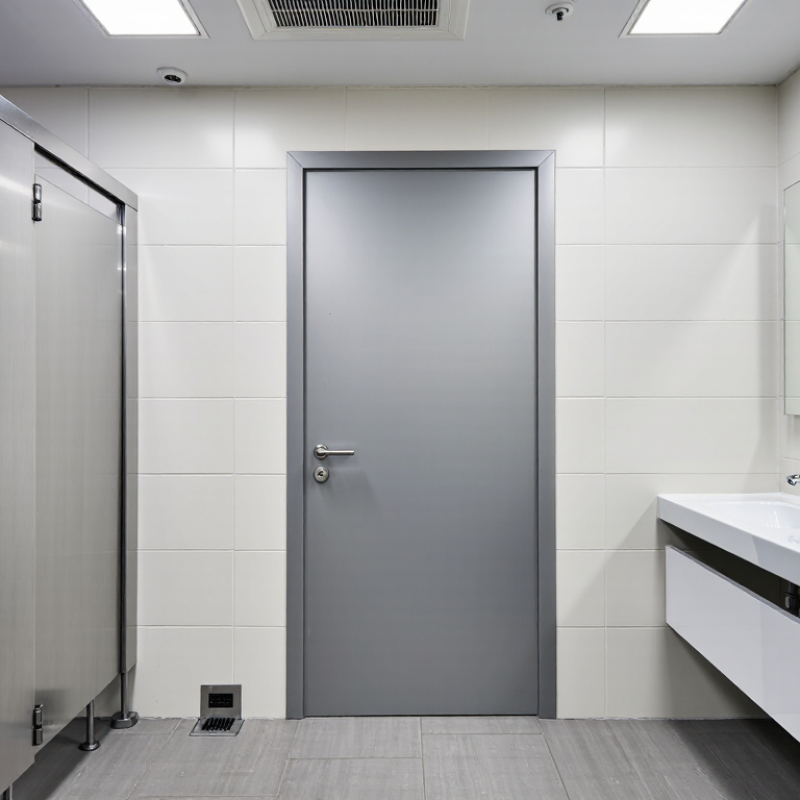
An aluminium washroom door is a door built with an aluminium frame or panel, designed for humid indoor spaces such as bathrooms, changing rooms, and shared washrooms. Aluminium resists moisture better than many untreated materials, so it is less likely to swell when steam settles on its surface. Many designs use a lightweight frame with an infill panel, frosted glazing, or ventilation slots. The choice affects privacy, light, and airflow. A door is only one part of the room, though; poor ventilation can still leave hinges and edges damp.
Its construction can vary. Some doors have a solid aluminium panel, while others combine an aluminium frame with glass or another suitable infill. Surface finishes may help with cleaning, but care depends on the finish and hardware. Check that the hinges, lock, and handle are suitable for frequent use and humid conditions. Small details matter. A narrow floor gap, for example, may help airflow, but it can also reduce privacy.
Tips: Measure the opening at several points before ordering, since walls and floors are not always perfectly square. Ask how the door should be cleaned, and avoid assuming every finish tolerates the same products. If the room feels damp after use, check the extractor fan and door ventilation; changing the door alone may not solve the problem.
How Is an Aluminium Washroom Door Constructed?
Why Choose an Aluminium Washroom Door?
An aluminium washroom door usually begins with an extruded frame. The profiles are cut, mitred, and joined around a lightweight core. The core may contain honeycomb board, compact laminate, or moisture-resistant composite material. These layers reduce weight while keeping the panel stable during daily use.
The surface often receives anodising or powder coating. This finish helps resist humidity, stains, and repeated cleaning. Stainless-steel hinges, a privacy lock, and adjustable strike plates complete the working assembly. EPDM or silicone seals can reduce rattling and limit water entering the frame. According to the International Aluminium Institute, recycling aluminium uses about 95% less energy than producing primary aluminium. That matters when durability and material recovery are considered together. Still, not every door performs equally. Poor joints, thin hardware, or an unsuitable core can shorten its service life.
Tips: Check the frame thickness, edge sealing, and hinge grade before purchasing. Ask whether the core tolerates constant humidity. A smooth finish is easier to clean, but it may show fingerprints. Leave enough floor clearance for ventilation and maintenance. On-site fitting also matters. Even a well-built door can warp or scrape when the opening is measured poorly.
What Practical Benefits Does Aluminium Offer?
Why Choose an Aluminium Washroom Door?
What Practical Benefits Does Aluminium Offer?
In a busy washroom, the door faces water, steam, fingerprints, and repeated impact. Aluminium handles these conditions with relatively little daily care. Its oxide layer helps resist corrosion, especially in humid interiors. A damp cloth and mild cleaner usually remove water marks and soap residue. That matters in schools, offices, restaurants, and public facilities.
The International Aluminium Institute reports that recycled aluminium requires about 5% of the energy used for primary aluminium production. This gives aluminium strong circularity potential when doors are recovered and recycled correctly. It is also lightweight, so installers can handle large door panels with less strain. Properly designed frames can support reliable opening cycles without feeling heavy.
But aluminium is not automatically the best answer. Thin panels may dent under rough treatment, and poor installation can create rattling or alignment problems. I have seen small gaps become obvious after months of heavy use. Careful measuring matters.
Surface choice matters too. Powder coating can provide colour consistency and an easier-clean finish, but damaged areas still need prompt attention. Ask for tested hardware, moisture-resistant fixings, and documented performance data. Practical quality comes from the complete door system, not the metal alone.
Where Are Aluminium Washroom Doors Commonly Used?
Aluminium washroom doors are commonly used in busy public facilities where durability and hygiene matter every day. You will often find them in shopping centres, airports, schools, hospitals, and office buildings. These locations experience constant traffic, so doors must handle repeated opening, closing, and cleaning.
They are also practical in gyms, swimming pools, leisure centres, and coastal properties. Aluminium resists moisture better than many untreated materials. This makes it suitable for changing rooms and shower areas, where water often reaches the door edges. In hospitals and clinics, smooth surfaces can support regular cleaning routines, although the frame design still needs careful attention.
Not every aluminium door suits every washroom. That matters. In my experience, poorly selected hinges or thin panels can create noise, movement, or early wear. Designers should check ventilation, privacy requirements, wheelchair access, and the expected traffic level before choosing a system. Public toilets may need stronger hardware than a small office washroom. Schools may benefit from safer edges and easy-to-repair components.
Aluminium washroom doors are also used in factories and staff facilities. Their light weight can make daily operation easier, especially for frequent users. However, finishes may show fingerprints or scratches in demanding environments. Regular inspection helps identify loose fittings, damaged seals, or corrosion near harsh cleaning chemicals. Good installation remains essential. The material helps, but it cannot correct poor planning.
What Factors Should Guide Door Selection and Maintenance?
Why Choose an Aluminium Washroom Door?
Door selection should begin with the washroom environment, not appearance. Aluminium resists moisture better than many untreated steel or timber alternatives. It also supports lighter doors, reducing stress on hinges and frames. However, aluminium is not maintenance-free. Poorly sealed joints can still collect water, soap residue, and bacteria.
The WHO and UNICEF Joint Monitoring Programme reported in 2023 that 3.5 billion people lacked safely managed sanitation in 2022. This highlights why hygienic, maintainable washroom details matter. Choose doors with smooth, non-porous surfaces and minimal dirt traps. Check whether the frame tolerates frequent cleaning and wet floors. Avoid sharp internal edges. They complicate cleaning. Ventilation also matters, because persistent humidity can damage hardware and finishes. In my experience, door alignment is often ignored until scraping begins. That small sound signals a larger maintenance issue.
Tips: Inspect hinges, locks, seals, and fasteners every month. Wipe spills quickly and use a neutral cleaner recommended for aluminium finishes. Do not use abrasive pads. Check the bottom clearance after floor cleaning changes. The International Aluminium Institute states that recycled aluminium requires about 5% of the energy used for primary aluminium production. Therefore, recycled-content options may support lower-impact specifications, but verify the supplier’s documentation. A lower-carbon material is not automatically the best door. Durability, repair access, hygiene, and replacement frequency still need honest review.
Why Choose an Aluminium Washroom Door?
Compare the approximate density of common door materials—a useful factor when considering panel weight.
Aluminium has a typical density of about 2,700 kg/m³. Actual door weight depends on panel thickness, core, and hardware; density alone does not determine suitability. For washroom use, also consider moisture-resistant construction, durable finishes, edge protection, and suitable hardware. Clean aluminium surfaces with mild soapy water and a soft cloth, then dry; avoid abrasive cleaners.
Conclusion
An Aluminium Washroom Door is a practical entrance solution made with lightweight, corrosion-resistant aluminium components and a suitable infill panel. Its construction typically includes a framed door leaf, hinges, handles, locks, and protective finishes designed to withstand frequent use and humid conditions. Depending on the setting, the infill may provide privacy, durability, or improved appearance while remaining easy to clean.
The main advantages of aluminium include low maintenance, resistance to moisture and rust, stable performance, and a modern, simple appearance. These doors are commonly used in offices, schools, hotels, healthcare facilities, retail spaces, and public buildings. When selecting one, consider the door size, traffic level, privacy needs, ventilation, hardware quality, surface finish, accessibility, and installation requirements. Regular cleaning with mild products, prompt repair of loose hardware, and periodic inspection of hinges, locks, and seals can help maintain safe, smooth, and long-lasting performance.

 Velox Window & Glazing